
A river is a thing of motion, talking as she goes
I have a deep personal connection with Wharfedale in the Yorkshire Dales and in particular the River Wharfe. In this is series of works centred on the river, I explore how I relate to its ancient and mystical heritage, the effects of the seasons and weather on its character and its timeless presence in the landscape.
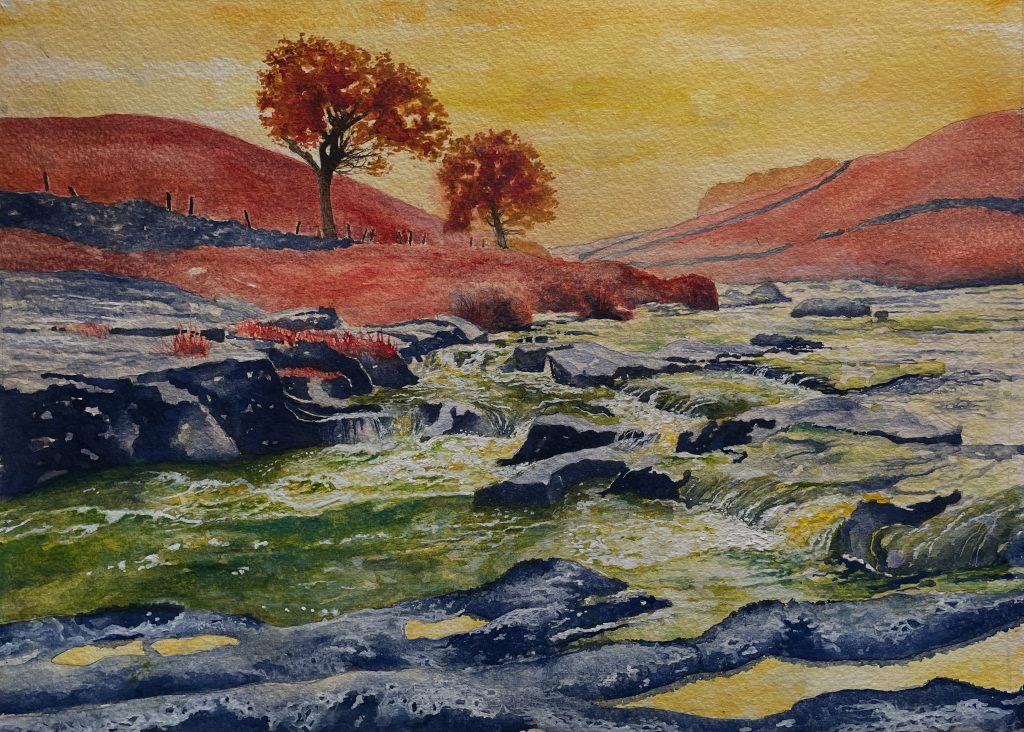
Above Yockenthwaite
The name “Wharfe”, at least in its present form, derives from the Old Norse “hverfi” meaning ‘a bend, crook, turn’, a name implying that the river was winding.
This painting is of the River Wharfe in Langstrothdale, about a mile downstream from its source at Beckermonds. I have tried to capture some of the quiet beauty of “the hills and river when the world is half asleep” that my Great Grandfather spoke of. Conjuring a summer morning with the early mists rising from the river while still conveying the energy of the joyous gills and rivulets assimilating to a gushing new impetuous river.
The water that makes up the River Wharf rises in the fells above Hawes but rather than the water flowing north down to meet the River Wensley, it flows south into the Oughtershaw Beck and Green Field Becks and at their confluence near Beckermonds, in Langstrothdale it becomes the Wharfe. From there is flows east and then south east taking the flows from several small streams originating on Yockenthwaite Moor and Horse Head Moor before turning south through Wharfedale, covering around 65 miles until it meets the River Ouse at Cawood.
As those that have read my posts know I have a deep connection with this river. This is the first in a series of pictures centred on the river; the effects of the seasons on its character and how it has effected, and has been effected, by the landscape around it.
This has been painted on Saunders Waterford 300lb paper using both watercolour and gouache
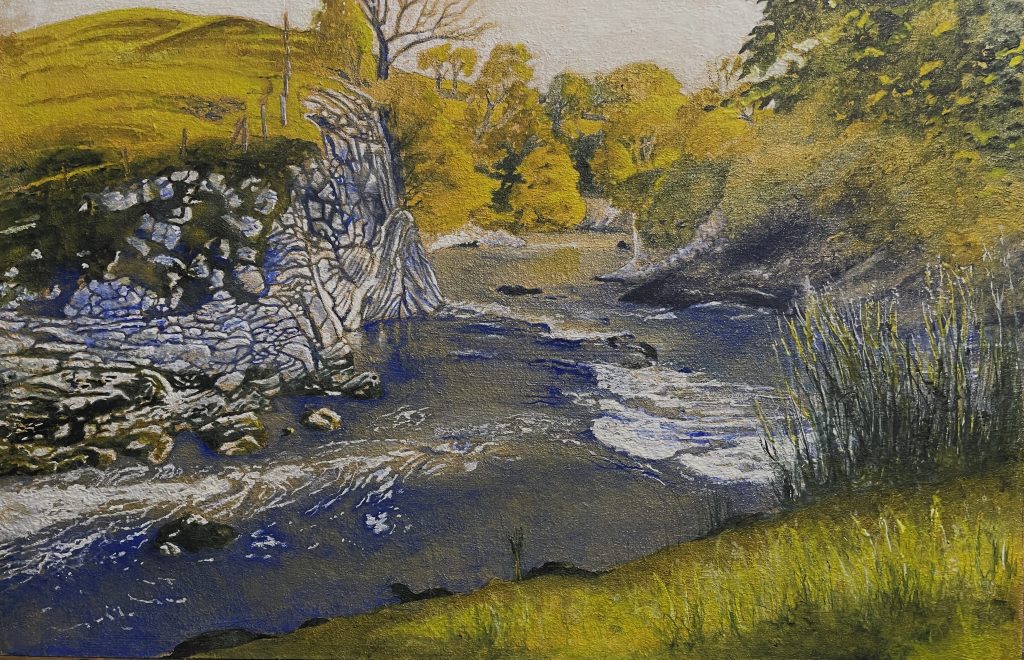
Loup Scar above Burnsall
If you follow the path south alongside the River Wharfe from Hebden Swing Bridge through the woods and glades, you will pass a spring boiling up near the river called St. Helen’s Well, and then another called St. Margaret’s Well. These wells were formerly connected with well-worship, and re-dedicated doubtless to saints after being sacred to pagan deities.
Your attention, however, will more likely be taken up with the river whose course suddenly turns for a short distance to the north-east due to a mass of limestone, this is Loup Scar.
Loup is said to be derived from “leap,” by most of the authorities who have written about the word; there is certainly a significant jump from the top of the cliff into a deep plunge pool beneath if you are brave enough. There is however also a suggestion that the origin of its name is linked to the Norman word for “wolf,” and so it may in fact be Wolf Scar.
The name Wharfe derives from the Old Norse hverfi meaning ‘a bend, crook, turn’, However, this Old Norse form was probably adapted from an earlier name: a Roman altar found in Ilkley is inscribed “VERBEIAE SACRUM” (‘sacred to Verbeia’) apparently referring to the River Wharfe as personified as a goddess.
In an often chaotic world, maybe take a moment to sit for a while and take in the view. Feel the damp from the ground and a light breeze against your face as the morning autumn sunshine breaks through the branches and warms your body. You may hear the fluting call of a kingfisher or the trill of a wren in the bushes while high above a buzzard wheels letting out its mournful call to the mountains.
If you sit quietly for long enough, maybe contemplating the ever constant river; the manifestation of Verbeia, you may even be lucky enough to hear the whistle of an otter or even spy its fleeting shadow on the bank.
This painting was from a walk we did on a beautiful October morning in 2023 and is painted on hardboard using #danielsmith pearlescent watercolour ground. I used watercolour, gouache and acrylic inks.
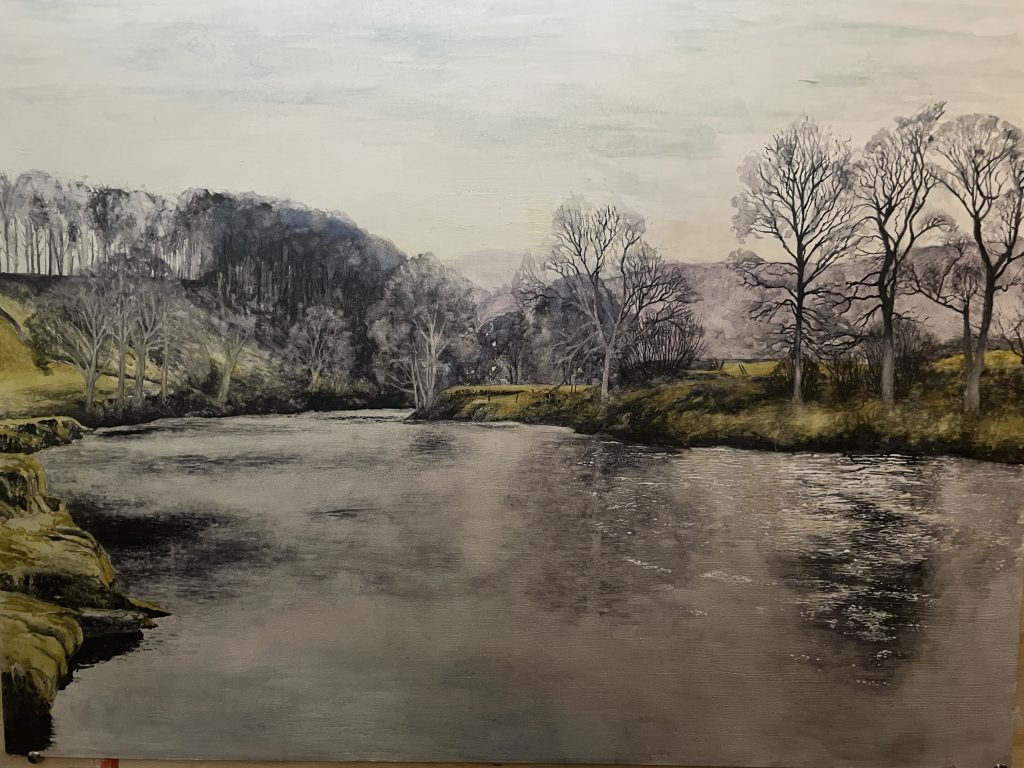
The Wharfe above Barden Bridge
A river is a thing of motion, talking as she goes. Before any Roman legion ever set foot in the dale, the Wharfe was already old and wise.
On this bright February morning she softly sighs, light glistening off her surface as the lowlands draw her down. She tells of Oughtershaw, far-off among the fells where the little rills that were her childhood gathered from lone mountain slopes and of Hubberholme, where Hubba the Dane raided and settled long before the Normans hunted the ancient thickets at the edge of the high moor. She tells of centuries of countless precarious lives, the fragments of which remain only in the shadows of the barns and meadows that hug her banks. Lives consumed in the mile upon mile of dry stone walls.
Suppose you linger, letting the Wharfe lay these spells upon you, The river’s wide, unhurried flow mirroring a never ceasing change. Colours; green and gold, grey and eager blue; and through the sky’s delicate filigree the waxing moon looks down on the river’s profound depths.
Little murmurs creep among the twigs and branches stirred by a soft breeze. Blackbirds call sharply from the hornbeam. Two wagtails dip and dance. A cockerel crows lustily from some distant Barden farm. Another answers him across the valley. Dogs here and there take up the cry.
Curlews lift their haunting calls from the riverside meadows.
The day seems eager to get on with its work; but enchantment is abroad. It is said that in dawn’s first light, as the night receding into the west still lingers in the undergrowth below the larch and beech on the hillside above Barden bridge, you can hear the music of unseen elves scarcely louder than the forest’s silence. Soft, Puck-like laughter seems to rustle through the branches, blending with the Green Folk’s forest song, an echo of all that is ancient and forever alive.
This picture is painted on plywood using #danielsmithpearlescent watercolour ground, watercolour and gouache.
Bolton Priory
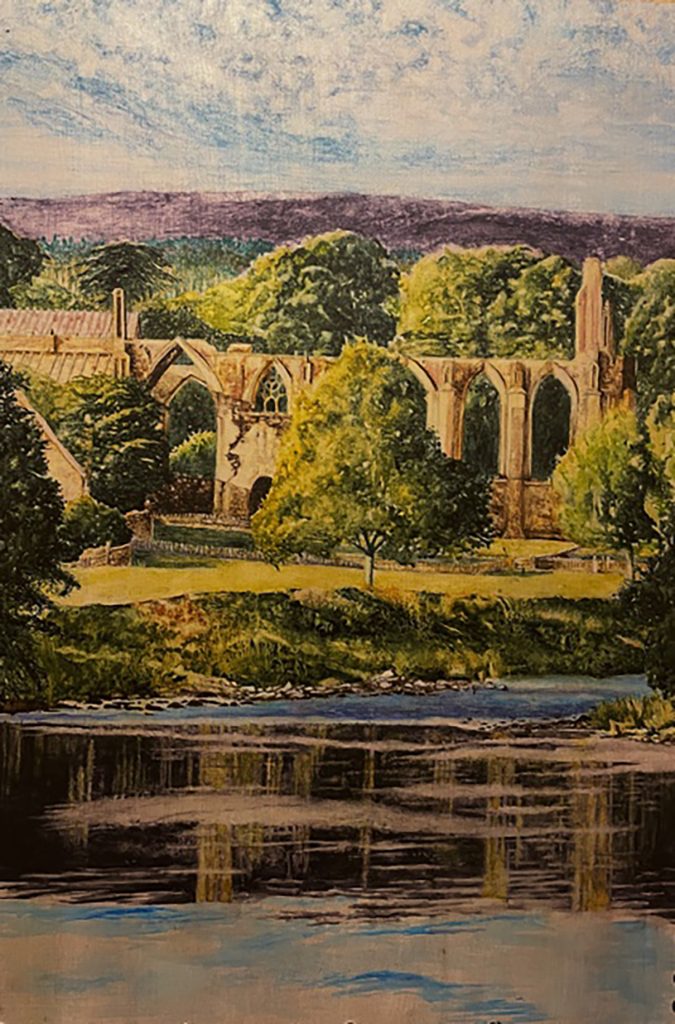
Bolton Priory, sitting on the banks of the River Wharfe feels like another spectral setting where time collapses and the years converge. A place brooding with medieval dreams. Where if you pause for a moment, the chants of monks still drift in the breeze.
The outer wall of the priory, now with flowers and grasses growing in the crevices of its fractured stones, must have once offered a stout barrier against intrusion but as you pass through its gaps, heart and mind are still quietened.
Many painters, including JMW Turner, have brought their genius to this place of a thousand memories. Enthralled by the love of Priory, the wooded banks of the river and the ever-watchful hills,
It is the hills above that make Bolton Priory, not a lost shrine where men and women worshipped in far-off days, but a living presence. Age after age, they have looked down on the Priory. They saw its foundations laid, watched its walls grow a little higher each week, until there came a day when the rising sun wiped the morning mists away and showed the final splendid vision there in the valley before them.
They listened to matin bell and vesper call, chiming low and silvery up the slopes. They saw the Abbey grow still finer, stretching to the heavens also its subsequent slow centuries long demise, as the once mighty building slowly degrades back into the land from where it came.
There is nothing that has happened to this child of their old age that these hills have not missed.
All however was not lost to the dissolution of the monasteries; the western half of the nave being preserved as a parish church so that the locals could continue their worship.
On Monday 9th August 1897, my Great Grandfather Arthur Reginald Smith married my Great Grandmother Alice Anne Wright in the Priory Church.
I like to imagine that it was sunny and warm that August day, the trees heavy with late summer leaves and the ever-attentive moors above looking down on the abbey ruins with a sense of reverence on this place of a thousand memories. I have attempted to conjure this while also capturing the summer evening sunshine that would have warmed the wedding party as they celebrated.
Text inspired by Halliwell Sutcliffe’s The Striding Dales. Original image of Bolton Priory by Andy Aughey
This picture is painted on plywood using #danielsmithpearlescent watercolour ground, watercolour and gouache.