
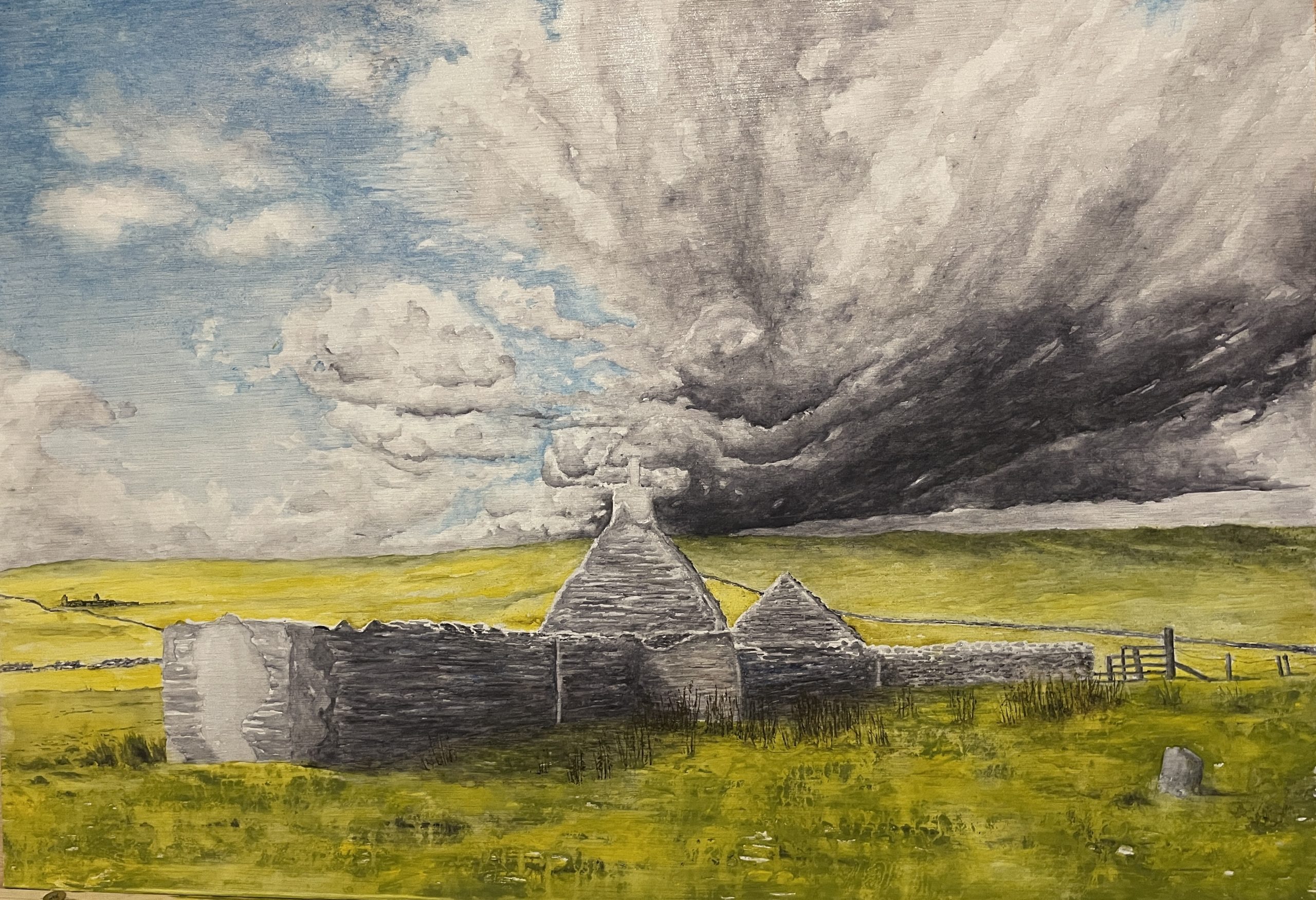
The Listeners
The Isle of Unst is the most northerly inhabited island of the Shetland archipelago and the village of Haroldswick is on its eastern side and one of the most northerly settlements in the British Isles. It is reputed to be here that the first Vikings landed on Shetland in AD875. London is over 800miles away, four times further than Bergen in Norway.
Above Haroldswick is Saxa Vord, Unst’s highest hill, where in 1962 the unofficial British record for wind speed was recorded at 177mph: just before the measuring equipment blew away!
This is a land of extremes and the people equally rugged and resilient.
When we visited, we came across a ruined blackhouse to the west of Haroldswick, one of the all too numerous similarly abandoned dwellings across Shetland, the Orkney, the Western Isles and the Highlands of Scotland.
As I climbed from the car the wind carried on it the sense of the approaching rain, the ruin silent – but aware.
I wondered about the generations of families that had lived in this dwelling, shaped by the wind and the long, cruel winters. How did these people survive? What did they dream of? Where did they go?
As Walter de la Mare wrote in The Listeners “..only a host of phantom listeners dwelt in the lone house then”. Maybe these listeners had a story to tell – maybe through the stone so meticulously placed generations before and the song of the wind across the high hill, but I am too distanced from those times now to decipher it.
As with the Traveller in De La Mare’s poem though, I felt in my heart their presence. Embracing their stillness I stood for a moment, feeling the strange weight of this place upon me. It was only as I turned to go, to leave this place to its phantoms that I was taken aback to see there in front of me, almost overlooked, was a grave stone.”
Painted on plywood using a combination of pearlescent and titanium white Daniel Smith watercolour ground and watercolour paint.
1 Thule – Wikipedia

Leave a Reply